

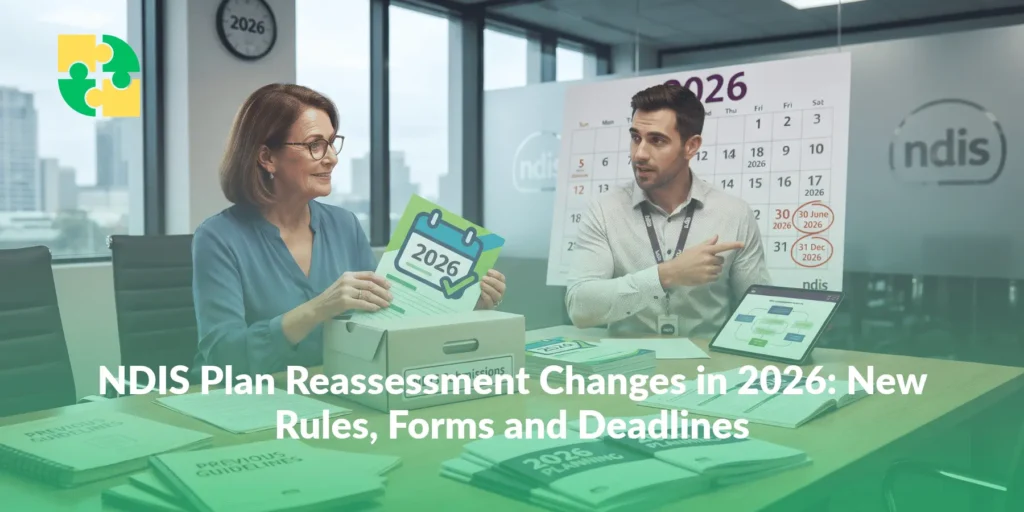
If you are an NDIS participant in Australia, understanding the new plan reassessment rules can help you prepare the right request, gather supporting evidence and avoid unnecessary delays.
Since 27 August 2026, new rules have changed who can request an unscheduled NDIS plan reassessment and what information must be provided. Requests must use the correct form and include the evidence required by the National Disability Insurance Agency (NDIA).
The NDIA states that it will make a decision within 90 days once it has the information it needs. Depending on your circumstances, it may agree to reassess your plan, decide not to reassess it, or vary your existing plan.
This guide explains the new rules, eligibility requirements, evidence, application forms, decision timeframes and other NDIS changes affecting participants in 2026 and 2027.
Important: This article provides general information based on official sources available as of 15 October 2026. Always check the latest NDIS guidance before submitting a request.
What Changed on 27 August 2026?
The National Disability Insurance Scheme Amendment (Securing the NDIS for Future Generations) Act 2026 introduced changes to NDIS planning and plan reassessments.
According to the NDIA, three important changes took effect on 27 August 2026:
1. Who can request a reassessment:
Only the participant, their plan nominee or their child representative can formally request an unscheduled plan reassessment.
2. Which form to use:
Requests must be submitted using the correct Plan Reassessment Request Form.
3. Supporting evidence
The request must explain what has changed and include the evidence needed for the NDIA to assess the request.
These rules apply to unscheduled plan reassessments. Participants can still request a plan variation for certain changes that are urgent, minor or short-term.
The NDIA has also advised participants to continue using their existing plans and supports as usual unless they are informed that a change affects them.
Who Can Request an NDIS Plan Reassessment?
Under the new rules, an unscheduled plan reassessment request can be made by one of the following:
- The participant: The person who has an NDIS plan.
- The participant’s plan nominee: A person formally appointed as their nominee under the NDIS.
- A child representative: A person authorised to represent a child in NDIS matters, commonly a parent or guardian.
Support coordinators, therapists, support workers and service providers can help participants prepare their applications and gather supporting documents. However, they cannot formally request an unscheduled reassessment in place of an authorised requester under these rules.
Giving a provider or support coordinator written consent to assist you does not, by itself, make them an authorised requester for a plan reassessment.
Your support team can still play an important role. For example, a treating occupational therapist may prepare an assessment, while a support coordinator may help organise documents and explain the application process.
Before submitting your request, confirm who is authorised to make it and ensure that the correct person completes the process.
When Can You Request a Plan Reassessment?
A plan reassessment may be appropriate when there has been a significant and ongoing change in your circumstances or support needs.
The NDIA identifies changes involving areas such as:
- Your ability to complete daily activities.
- Your living arrangements.
- Your education or employment circumstances.
- The informal support available to you.
The change must meet the applicable NDIS requirements. The NDIA will consider the information provided, how the change relates to your disability and whether your current plan continues to meet your needs.
For example, if a lasting change in your functional capacity means that your existing supports no longer meet your daily needs, you may wish to discuss a reassessment with your NDIS contact.
A temporary problem may require a different approach. If your needs are urgent, minor or short-term, a plan variation may be more suitable.
Remember: A change in circumstances does not automatically guarantee a reassessment, a new plan or additional funding. The NDIA must consider your individual situation and make a decision.
Plan Reassessment vs Plan Variation: What Is the Difference?
Choosing the correct type of plan change can help you avoid unnecessary delays.
| Feature | Plan Reassessment | Plan Variation |
|---|---|---|
| Purpose | A full reassessment that may result in a new plan. | A change to specified parts of your existing plan. |
| Typical Circumstances | A significant and ongoing change in support needs or circumstances. | Certain urgent, minor, or short-term changes. |
| Application | Plan reassessment request. | Plan variation request or the applicable NDIA contact process. |
| Possible Outcome | A new plan, no reassessment, or a plan variation. | A change to your existing plan or a decision not to change it. |
| Decision Timeframe | Within 90 days once the NDIA has the information it needs. | Generally within 21 days once the NDIA has the information and evidence it needs. |
A plan reassessment involves a broader review of your support needs and may result in a replacement plan.
A plan variation changes specified parts of your existing plan without requiring a full reassessment. The NDIA may also decide that a variation is more appropriate than the reassessment you requested.
If you are unsure which option is right for you, speak with your NDIS contact. Your support coordinator may also help you understand your current plan and prepare for that discussion.
Which Forms Do You Need?
The NDIA provides separate forms for plan reassessments and plan variations.
Plan Reassessment Request Form
Use the current Plan Reassessment Request Form when you want the NDIA to consider whether a significant and ongoing change warrants a reassessment.
Be prepared to explain:
- What has changed in your circumstances or support needs.
- When the change occurred.
- How the change affects your daily life.
- Why your current plan no longer meets your needs.
- What supporting evidence you have provided.
Explain your circumstances clearly and use practical examples.
For instance, rather than writing that your support needs have increased, describe which daily activities have become more difficult, what has changed and why your existing supports are no longer sufficient.
Plan Variation Request Form
A plan variation may be more suitable when you need a change to part of your current plan rather than a full reassessment.
The NDIA provides a Plan Variation Request Form. You can also contact my NDIS contact or the NDIA to discuss the changes you need.
If your situation is urgent, contact the NDIA to discuss your needs instead of relying solely on a written application.
Always download the latest version of the relevant form from the official NDIS website.
What Evidence Do You Need for a Reassessment?
Supporting evidence helps the NDIA understand what has changed and whether your existing plan continues to meet your needs.
Depending on your circumstances, relevant documents may include:
- Reports from treating health professionals.
- Occupational therapy or physiotherapy assessments.
- Reports from your GP or relevant specialist.
- Information explaining changes in daily activities and functional capacity.
- Documents explaining changes in living arrangements or informal support.
- Professional recommendations explaining which supports may be required and why.
Make sure your evidence explains the change
Evidence should explain more than the fact that your needs have increased. It should help the NDIA understand the nature of the change and its practical impact.
For example, a report about a change in mobility might explain how it affects personal care, transfers, household activities or participation in the community.
Where a request concerns functional capacity, check the current form and NDIA guidance to determine what evidence must be provided by a treating professional.
Check the evidence requirements before lodging your request
The NDIA requires supporting evidence for plan reassessment requests. The evidence needed depends on the reason for your request and the applicable requirements.
Do not assume that an older report will automatically be accepted or rejected. Check the current guidance for any requirements concerning the type, content or timing of your evidence.
It is also sensible to speak with your treating professional early. Preparing an assessment or report can take time, and you want your evidence to address the questions relevant to your request.
The 90-Day Decision Timeframe Explained
The NDIA states that it will make a decision within 90 days once it has the information it needs to assess your plan reassessment request.
There are three possible outcomes:
1. Reassess your plan: The NDIA agrees to proceed with a reassessment.
2. Do not reassess your plan: The NDIA decides that the evidence does not justify a reassessment.
3. Vary your plan: The NDIA decides that changing specified parts of your existing plan is more appropriate.
The NDIA will notify you of its decision and explain the reasons behind it.
Does the 90-day period mean you will receive a new plan?
No. The 90-day timeframe relates to the decision about your request, not necessarily the completion of a reassessment or the approval of a replacement plan.
If the NDIA agrees to reassess your plan, further steps will follow. If a new plan is approved, the NDIA states that it will send you a copy within seven days of approval.
You can continue using your current plan while the NDIA decides whether to reassess it.
What happens if the NDIA does not decide within 90 days?
The legal consequences of a missed decision deadline depend on the applicable legislation and the circumstances of the request.
If your request remains undecided, contact the NDIA to confirm its status and ask about the review rights available to you. Seek advice from your NDIS contact or an independent disability advocate if you need help understanding your options.
Do not assume that a new plan or additional funding will be approved automatically.
What if you disagree with the NDIA’s decision?
The NDIA provides an internal review process for eligible decisions.
Read your decision letter carefully. It should explain the decision, the reasons behind it and the applicable process for requesting a review.
Pay attention to any deadline for lodging your review request. An independent disability advocate may be able to help you understand your options and prepare the necessary information.
What Should You Do if Your Situation Is Urgent?
If your support needs change suddenly, contact the NDIA to explain your circumstances and discuss the appropriate next step.
A plan variation may be suitable for certain urgent, minor or short-term changes. The NDIA can consider whether a variation is appropriate based on your circumstances and the information provided.
While waiting for a decision, continue using your existing plan and support as usual, subject to your plan’s terms and any advice from the NDIA.
Do not assume that submitting a reassessment request automatically changes your funding or authorises additional support.
If you are unsure whether your situation requires a reassessment or variation, your NDIS contact can help you understand the available process.
Other Important NDIS Changes in 2026 and 2027
The reassessment rules are part of broader NDIS reforms. Participants should also understand the changes affecting support budgets and future planning arrangements.
From 1 October 2026: Changes to Some Support Budgets
The NDIA announced changes to two support budget categories:
- Social, Economic and Community Participation.
- Improved Daily Living Skills.
The changes are being applied progressively as plans are created or reassessed from 1 October 2026, or renewed from 1 February 2027.
The impact will vary between participants because NDIS plans are based on individual goals, circumstances and support needs.
The NDIA has also identified certain supports that are excluded from the budget reductions. These include specified employment supports, disability-related health supports, high-intensity supports and some other categories. Essential day-to-day supports, such as assistance with personal care, are also among the supports identified as unaffected.
Check the NDIA’s published guidance and exclusions before making decisions about your plan. A reassessment may affect more than the specific change that prompted your request, so it is important to understand how the current rules apply to your circumstances.
From 1 February 2027: Plan Renewals
The NDIA has announced that the updated budget arrangements will also apply to plans renewed from 1 February 2027.
Further planning reforms are being introduced progressively. Participants should check official announcements for the commencement dates and requirements relevant to their plans.
Do not assume that every participant will experience the same changes. The impact depends on the plan, support categories and applicable rules.
Further Changes to Claims and Record-Keeping
The 2026 legislation also includes measures relating to claims, provider arrangements and record-keeping.
The requirements and commencement dates may differ between measures. Participants, nominees and providers should check the current official guidance to establish which obligations apply to them.
These changes are separate from the 90-day timeframe for deciding a plan reassessment request.
Checklist Before Submitting Your Request
Use this checklist to prepare your application.
- I am the participant, plan nominee or child representative authorised to submit the request.
- I have considered whether a plan variation would be more suitable.
- I have explained the significant and ongoing change in my circumstances or support needs.
- I have downloaded the current Plan Reassessment Request Form.
- I have explained when the change occurred and how it affects my daily life.
- I have checked which supporting evidence is required.
- I have included the relevant evidence available to me.
- I have kept a copy of the form and supporting documents.
- I have recorded the date I submitted my request.
- I know how to contact the NDIA if my situation is urgent or I need an update.
Final Thoughts
The NDIS plan reassessment changes introduced in August 2026 make it especially important to use the correct form, ensure the request is made by an authorised person and provide the evidence required by the NDIA.
Before submitting a request, consider whether a reassessment or a plan variation better suits your circumstances. Explain the change clearly, keep copies of your documents and check the latest NDIA guidance about evidence and decision timeframes.
Understanding the rules before you apply can help you prepare a clearer request and make informed decisions about your existing plan.
Because NDIS legislation and implementation arrangements continue to evolve, verify the requirements that apply to your situation before taking action.
Disclaimer: This article provides general information and is not legal, financial or individual NDIS advice. For guidance about your own plan, contact the NDIA, your NDIS contact or an independent disability advocate.
Frequently Asked Questions
- Can my support coordinator submit a reassessment request for me?
Under the rules introduced on 27 August 2026, the formal request must come from the participant, their plan nominee or their child representative. A support coordinator can still help prepare documents and gather evidence.
- Can my therapist provide supporting evidence?
Yes. Reports from treating health professionals and therapists may help explain changes in functional capacity and support needs. Check the current NDIA requirements to establish what evidence is needed for your particular request.
- Will the NDIA make a decision within 90 days?
The NDIA states that it will decide within 90 days once it has the information it needs. Keep a record of your submission and contact the NDIA if you need to check the status of your request.
- Could my funding change after a reassessment?
Yes. A reassessment may result in a replacement plan, and funding can differ depending on the NDIA’s assessment and the rules that apply. Changes to certain support budgets are also being introduced from 1 October 2026. Review the current guidance before deciding whether to request a reassessment.
- Do I need to stop using my existing plan while waiting?
No. The NDIA advises participants to continue using their existing plans and supports as usual unless they are told that a change affects them.