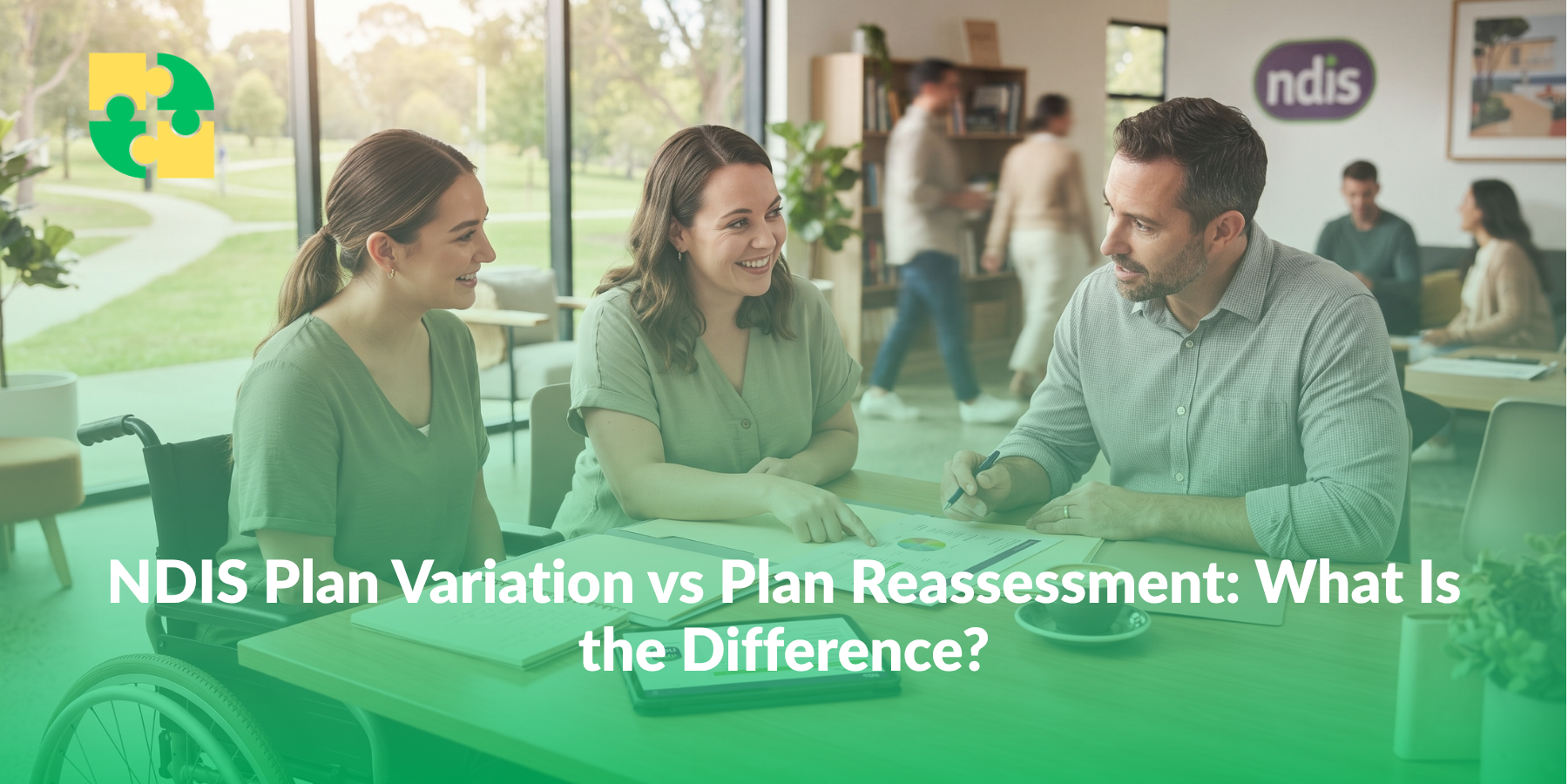



In simple terms: an NDIS plan variation changes part of your existing plan, while a plan reassessment is used when your circumstances or support needs have changed significantly and your current plan may no longer meet your needs.
The two processes can sound similar because both can be used when your NDIS plan needs to change. However, they are designed for different situations.
A variation generally deals with a specific change that can be made within your existing plan. A reassessment is broader and may lead to a new plan with different supports.
It is also important to remember that the NDIA decides which type of plan change is appropriate. Asking for a variation or reassessment does not guarantee that the NDIA will use that particular pathway.
Why are plan variations and reassessments often confused?
Both processes allow changes to an NDIS plan, but the scope is different.
A plan variation changes part of your current plan when the requested change can be made without replacing the whole plan.
A plan reassessment is used when there has been a significant change in your circumstances or support needs and your existing plan no longer meets those needs. A reassessment can result in a new plan.
The NDIA considers the information and evidence you provide, as well as how the requested change fits with the rest of your plan.
What is an NDIS plan variation?
A plan variation changes part of your current NDIS plan. It can be used when the change you are requesting fits within your overall package of NDIS support and a full reassessment is not necessary.
Examples of changes that may be made through a variation include:
- Changing your plan reassessment date
- Updating your goals
- Changing your statement of supports
- Changing how funding component amounts are managed
- Correcting a small or technical error in your plan
- Adding certain supports where the relevant requirements are met
- Providing crisis or emergency funding when you have an urgent change in support needs
A variation may also be used for certain high-support-needs participants under the new NDIS reform arrangements.
For example, if your circumstances change suddenly and you need additional support to maintain access to necessary NDIS support, a variation may be considered depending on your situation and the evidence available.
Does a plan variation restart your plan?
No. A plan variation changes part of your existing plan rather than starting the planning process again from the beginning.
The NDIA may issue a new version of the plan after making the variation. The change can also affect the plan reassessment date where permitted under the rules.
A plan variation does not mean that the plan can continue indefinitely without reassessment. Current NDIS rules place limits on how long a plan can continue without a reassessment.
What is an NDIS plan reassessment?
A plan reassessment is used when you need significant changes to your NDIS support because your circumstances or ongoing support needs have changed.
This may happen when your current plan no longer meets your needs because of significant and ongoing changes to areas such as:
- Your ability to carry out daily activities
- Your disability-related support needs
- Your living arrangements
- Your education or study
- Your employment or work circumstances
- The informal support available from family or other people
A reassessment may also happen when your scheduled reassessment date is approaching and the NDIA needs to work with you to create a new plan.
If a participant requests a reassessment before the scheduled reassessment date, the request needs to meet the current requirements. Since the 2026 legislative changes, participants can request this type of reassessment where there has been a significant and ongoing change to their functional capacity and support needs, or to their living, education, work or informal support arrangements.
The NDIA has up to 90 days to decide whether to reassess a plan after receiving the required information.
What evidence is needed for a plan reassessment?
When requesting a reassessment because your circumstances have changed significantly, you need to provide supporting information and evidence.
This may include reports or assessments from relevant professionals such as:
- Your GP
- Occupational therapist
- Physiotherapist
- Psychologist
- Specialist
- Other treating health professionals
- Relevant support workers
The evidence should explain what has changed, how the change affects your support needs and why your current plan no longer meets those needs.
Current NDIS guidance generally expects reassessment evidence to be recent and to relate to your current plan and the change you are asking the NDIA to consider.
You can continue using your current plan while the NDIA decides whether a reassessment will take place.
NDIS plan variation vs reassessment
| Comparison | Plan Variation | Plan Reassessment |
|---|---|---|
| Main purpose | Change part of an existing plan | Consider significant changes to your plan and circumstances |
| Scope | Targeted change | Broader consideration |
| Existing plan | Part of the current plan is changed | The current plan may be replaced with a new one |
| Funding | A particular funding or support arrangement may be changed | Your overall NDIS support may be reconsidered |
| Typical situation | A specific change is needed | Your current plan no longer meets your needs because your circumstances or support needs have significantly changed |
| Evidence | Depends on the type of change | Supporting evidence is generally required for significant-change requests |
| Possible outcome | A varied plan, or no change | A new plan, no reassessment, or in some cases a plan variation |
The distinction is not simply about whether a change is “small” or “large”. The NDIA considers the nature of the requested change, your circumstances, the evidence provided and how the change fits with your overall plan.
How do you know which one may apply?
A useful question is:
Can the change be made to one part of my current plan without needing to reconsider my overall support needs?
If yes, a plan variation may be appropriate.
For example, you may need a particular administrative correction, a change to your goals or another permitted adjustment to your existing plan.
If your circumstances or ongoing support needs have changed significantly and your current plan no longer meets your needs, a reassessment may be more appropriate.
This could involve a substantial change in your daily support requirements, living arrangements, work or education, or the informal support available to you.
You do not necessarily have to determine the correct pathway yourself. The NDIA will consider your request and the information you provide before deciding how your plan should be changed.
What happens after you ask for a plan change?
The process depends on the type of change you are requesting.
For a plan variation, you, your plan nominee or child representative can request a variation. You may need to provide information or evidence supporting the requested change.
For a reassessment, a participant, plan nominee or child representative must submit the relevant reassessment request and supporting information when asking for a significant change outside a regular reassessment.
The NDIA then considers the request and evidence.
There are several possible outcomes. The NDIA may:
- Vary your existing plan
- Reassess your plan and create a new plan
- Decide that no change should be made
This means the pathway you request and the final outcome are not always the same.
What if the NDIA says a variation is not appropriate?
The NDIA may decide that your requested change cannot be dealt with separately from the rest of your plan.
For example, if the change would require a broader consideration of your support needs, the NDIA may determine that a reassessment is more appropriate.
The NDIA may also ask for additional information or evidence before making a decision.
A variation request not proceeding does not necessarily mean that the underlying issue has been ignored. It may mean that the NDIA considers a different type of plan change is needed.
How can you support your request?
Whether you are asking for a variation or reassessment, clear and relevant information can help the NDIA understand your situation.
1. Explain what has changed
Be specific about what happened and when.
Instead of simply saying that your support needs have increased, explain what is different in your daily life and what support you now require.
2. Explain the practical impact
Describe how the change affects your everyday activities, independence, safety or ability to work towards your NDIS goals.
3. Provide relevant evidence
Include recent reports or other supporting information where appropriate.
The evidence should relate directly to the change you are asking the NDIA to consider.
4. Explain why your current plan is not working
If you are requesting a reassessment, explain why your existing supports no longer meet your needs.
This helps distinguish a significant change in circumstances from a temporary issue that may be managed within your current plan.
5. Keep records
Keep copies of your forms, reports and other documents. It can also help to record important dates, conversations and decisions.
A support coordinator, my NDIS contact or another appropriate support person may be able to help you understand the process and prepare information, depending on your circumstances.
What if you disagree with the NDIA’s decision?
If the NDIA makes a decision about your plan that you disagree with, you may be able to request an internal review.
This can apply to certain decisions about plan variations and reassessments. The review process depends on the specific decision you have received.
If you remain dissatisfied after an internal review, further review may be available through the Administrative Review Tribunal (ART), depending on the decision and applicable rules.
Check the information included with your decision for details about your review rights and any applicable time limits.
You can also seek assistance from an appropriate disability advocacy organisation or support service.
NDIS rules are changing
The NDIS is undergoing significant reform, and some of the new planning rules have already taken effect.
The Australian Parliament passed the National Disability Insurance Scheme Amendment (Securing the NDIS for Future Generations) Bill 2026 in August 2026. Changes are being introduced in stages.
For plan changes, important reforms include changes to how participants request reassessments before their scheduled reassessment date. Participants can still request plan changes when there is a significant change in their circumstances or support needs, while short-term or urgent changes can continue to be considered through plan variations.
Further changes are scheduled from October 2026 and into 2027 and 2028, including changes affecting support budgets, plan renewals and the wider planning process.
Because these reforms are being introduced progressively, information about NDIS plan changes can become outdated quickly.
Before submitting a variation or reassessment request, check the latest information from the NDIS and make sure you are using the current form and process.
Conclusion
The easiest way to understand the difference is to look at the scope of the change.
A plan variation changes part of your existing NDIS plan when the requested change can be made without replacing the whole plan.
A plan reassessment is used when your circumstances or ongoing support needs have changed significantly and your current plan may no longer meet those needs. It can result in a new plan.
The NDIA makes the final decision about which pathway applies. If you are unsure, explain clearly what has changed, provide relevant evidence and ask the NDIA or your NDIS contact about the appropriate process.
A clear, factual request that explains the change, its impact and the support you need can make it easier for the NDIA to understand your circumstances and consider your request.
FAQs
1. What is the difference between an NDIS plan variation and a reassessment?
An NDIS plan variation changes a specific part of your existing plan, while a reassessment considers your circumstances and support needs more broadly. A variation updates your current plan, whereas a reassessment may result in a new plan.
2. Can I request an NDIS plan reassessment before my plan expires?
Yes, you may request a reassessment before your scheduled date if your circumstances meet the applicable requirements. Under the updated rules, significant and ongoing changes to your support needs, functional capacity or living arrangements may be relevant. The NDIA assesses each request.
3. Does an NDIS plan variation change my plan end date?
Not necessarily. A variation generally updates your existing plan, but it may change your reassessment date where permitted under the rules. The applicable limits and conditions depend on your plan and the type of variation.
4. What evidence do I need to request an NDIS plan reassessment?
You may need recent supporting evidence explaining how your circumstances or disability-related support needs have changed. This can include reports from an occupational therapist, GP, psychologist, physiotherapist or other relevant professional. The evidence should explain why your current plan may no longer meet your needs.
5. Can I challenge an NDIS decision about a plan variation or reassessment?
You may be able to request an internal review if you disagree with a reviewable NDIA decision. Depending on the outcome and the type of decision, you may also be able to apply to the Administrative Review Tribunal (ART). Check your decision letter for applicable review rights and deadlines.