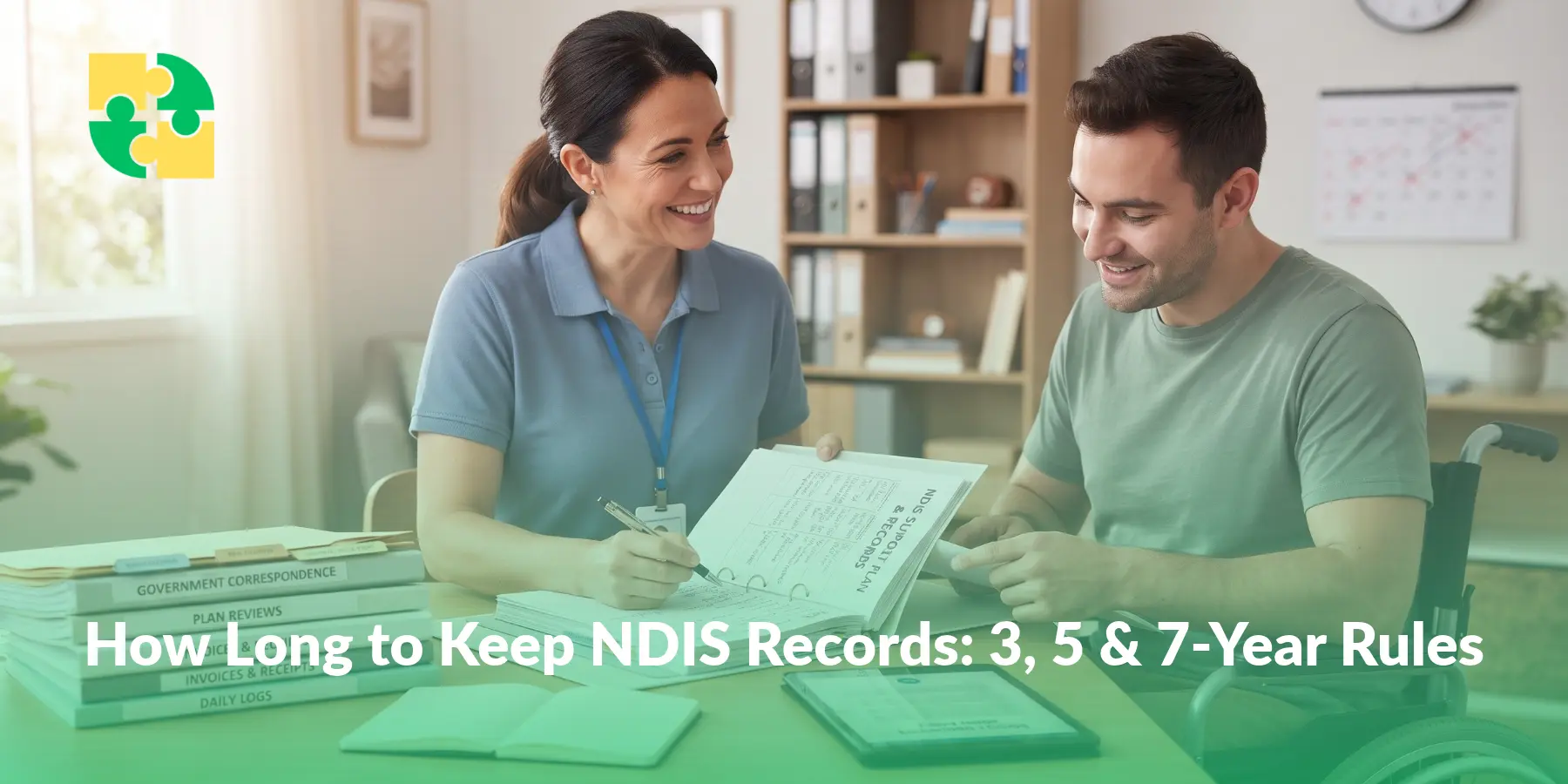



Certain NDIS claim-related records must be kept for 3 years by participants, 5 years by other people who make claims, and 7 years by providers. Self-managed participants should also be aware of guidance recommending that receipts and spending records be kept for 5 years. The exact requirement depends on your role and the type of record.
Keeping accurate records is an important part of managing National Disability Insurance Scheme (NDIS) funding. Whether you are a participant, a nominee, a plan manager or a service provider, the right documents can help demonstrate how funding was used and support accurate claims.
Record-keeping requirements vary according to your role and the documents you hold. In this guide, we explain the 3, 5 and 7-year periods, the records you may need to keep and practical ways to organise them.
Why Is NDIS Record Keeping Important?
NDIS records help show that funding has been used appropriately and that claims relate to support provided under a participant’s plan.
Good record keeping can help you:
- Demonstrate how NDIS funding has been spent.
- Support claims with relevant evidence.
- Respond to requests for information or reviews.
- Resolve payment or service-related disputes.
- Maintain clear communication between participants, nominees, plan managers and providers.
- Meet applicable legal and administrative obligations.
Missing or incomplete records can make it harder to verify a claim or explain a payment. Establishing a consistent filing system can help prevent these problems.
Understanding the 3, 5 and 7-Year Rules
Different retention periods may apply depending on who makes a claim and the type of record involved.
| Person or organisation | How long to keep records |
|---|---|
| Participants who make NDIS claims | 3 years for prescribed claim-related records |
| Other people who make claims, including some nominees | 5 years for prescribed claim-related records |
| NDIS providers | 7 years for prescribed claim-related records |
| Self-managed participants | NDIS guidance also recommends keeping receipts and spending records for 5 years |
Important: These periods do not automatically apply to every document you hold. The legal requirements cover specified types of claim-related records, and separate tax, employment, business and incident-management obligations may apply. Check the latest official NDIS guidance for your circumstances.
1. NDIS Participants: What Records Should You Keep?
Participants who make claims should retain the relevant evidence required to support those claims. This is particularly important for people who manage their own NDIS funding.
Useful records may include:
- Receipts and tax invoices.
- Proof of payment.
- Provider names and Australian Business Numbers (ABNs), where applicable.
- Dates and descriptions of support received.
- The quantity or hours of support provided.
- Amounts paid and relevant support details.
- Correspondence about claims or payments.
Under the relevant legislation, participants who make claims generally need to retain prescribed claim-related records for 3 years from the date the claim is made, subject to any applicable shorter period under the rules.
What if you self-manage your funding?
NDIS guidance has also advised self-managed participants to keep receipts, invoices and spending records for 5 years. This is important because not every document necessarily falls under the same retention requirement.
Practical tip: Keep invoices, proof of payment and related support information together. If you also hold payroll, employment or tax records, check the separate requirements that apply to those documents before deciding when to dispose of them. If you need help organising your supports and planning ahead, our assistance in managing life stages service can help you stay on track.
2. Plan Nominees and Other People Making Claims
A plan nominee may help a participant manage their NDIS plan and funding. Where a nominee or another person makes a claim, a different retention period may apply from the period for a participant who makes their own claim.
Under the relevant legislation, a person who is not an NDIS provider or participant and who makes an NDIS claim generally has a 5-year retention period for prescribed claim-related records, subject to any applicable shorter period.
Depending on their responsibilities, useful records may include:
- Receipts and invoices.
- Claim confirmations and payment information.
- Details of supports purchased.
- Communications with providers or the NDIA.
- Documents showing how funding was managed.
The 5-year period should not be assumed to apply to every document held by every nominee. The applicable requirement depends on the role the person performs and whether they are making a claim.
Nominees should also store participants’ personal and financial information securely. Where a participant has complex needs, specialist support coordination can help coordinate their supports and providers.
3. Plan Managers: Keeping Clear Financial Records
Plan managers administer payments and funding-related processes for participants who choose NDIS plan management. Their records should provide a clear picture of the claims they process and the supports those claims relate to.
Relevant documents may include:
- Provider invoices.
- Payment and transaction records.
- Claim histories.
- Information about supports delivered.
- Communications about disputed or corrected claims.
- Other documents required under applicable NDIS rules.
The Australian Government’s implementation guidance identifies a 3-year retention period for relevant NDIS claim records held by plan managers. However, other laws, contracts or professional obligations may require additional records to be kept for longer.
Plan managers should check the requirements for each category of record rather than applying a single timeframe to every document.
A consistent filing system also makes it easier to reconcile payments, answer enquiries and respond to requests for supporting evidence.
4. NDIS Providers: Understanding the 7-Year Requirement
NDIS providers have responsibilities for documenting the support they deliver and the claims they make.
Relevant records may include:
- Invoices and payment records.
- NDIS service agreements.
- Support logs and case notes.
- Rosters and timesheets.
- Dates and duration of support.
- Information describing the supports provided.
- Communications about changes, cancellations or disputed services.
Under the relevant legislation, providers generally need to retain prescribed records relating to an NDIS claim or the support associated with that claim for 7 years from the date the claim is made, unless a shorter period is prescribed by the applicable rules.
The starting point matters: this claim-related period is not automatically calculated from the day the service was delivered.
Providers should ensure staff understand what information needs to be recorded and where it should be stored. Complete and accurate records can help providers respond to audits, complaints, payment enquiries and compliance reviews.
5. Incident Records May Have Separate Requirements
Incident records are subject to requirements that may differ from those for ordinary claim-related documents.
NDIS Commission guidance includes a 7-year retention requirement for certain incident-management records. The applicable starting point can depend on the type of record and whether the incident was notified to the Commission.
Incident documentation may include:
- Details and date of the incident.
- Actions taken in response.
- Follow-up and review information.
- Relevant communications.
- Notifications made to the NDIS Commission.
Providers should check the specific incident-management and reporting requirements that apply to their services. They should not assume that the general retention period for claim records automatically covers every incident or complaint record.
When Does the Retention Period Start?
The starting point depends on the particular legal requirement.
- Prescribed participant claim records:
generally, the period begins on the day the claim is made.
- Prescribed provider claim records:
generally, the period begins on the day the claim is made.
- Records relating to claims made by other people:
generally, the period begins on the day the claim is made.
- Incident and complaint records:
The starting point depends on the applicable incident-management requirement and the
type of record.
- Tax and employment records:
separate rules may determine how long records must be kept and when the period begins.
Keep important dates clearly recorded. Before deleting a document, check the rule that applies to that specific record.
Tips for Managing NDIS Records
1. Use digital folders
Create folders for invoices, receipts, payments and service agreements. Organise them by provider, participant or NDIS funding period, depending on your needs.
2. Use clear file names
Include useful details such as the provider name, support date and document type. This makes individual records easier to find.
3. Keep supporting documents together
Where possible, store invoices, proof of payment and related support information in the same place.
4. Back up your files
Use a secure backup system to reduce the risk of losing important documents if a device fails or a file is accidentally deleted.
5. Protect personal information
NDIS records may contain sensitive personal and financial details. Limit access to authorised people and use secure storage.
6. Review your records regularly
Check that documents are readable, complete and correctly filed. Regular reviews can help identify missing invoices or payment information.
7. Check before deleting records
Do not rely only on the age of a document. An audit, dispute, tax obligation or separate legal requirement may mean that you need to retain it for longer.
Conclusion
Good NDIS record keeping helps participants, nominees, plan managers and providers maintain clear evidence of claims and support. Well-organised records can also make it easier to prepare for your next NDIS plan review.
The 3, 5 and 7-year periods provide a useful guide, but they should not be applied automatically to every document. The safest approach is to understand your responsibilities, keep records organised and secure, and check the latest official requirements before deciding when a document can be deleted. If you are looking for an NDIS provider in Sydney, Deep Connections Community Services can help you find supports that suit your goals.
Disclaimer: This article provides general information only and is not legal, tax or financial advice. NDIS requirements and guidance may change. Always confirm the current rules that apply to your role and the records you hold.
Frequently Asked Questions
No. The applicable period depends on the type of record and your role. Certain participant claim records generally have a 3-year period, some claims made by other people have a 5-year period, and prescribed provider claim records generally have a 7-year period. Separate rules may apply to incident records and other documents.
Not necessarily for every document. Certain prescribed claim-related records generally have a 3-year period, while NDIS guidance also recommends that self-managed participants keep receipts, invoices and spending records for 5 years. Check the requirements that apply to each type of record before deleting it.
Not necessarily. The applicable period depends on the role and the type of claim or record. Official implementation guidance identifies 3 years for relevant plan-manager claim records, while a 5-year period generally applies to claims made by people who are not providers or participants.
Digital storage can be a practical option, provided the records remain readable, accessible and secure and meet any applicable requirements. Records required under the legislation must be in English or readily accessible and convertible into English.
Missing records may make it harder to demonstrate that funding was used correctly. Depending on the circumstances and applicable requirements, this may lead to further enquiries or other consequences. Keeping complete and accurate records helps reduce this risk.
Check first. An ongoing dispute, an audit, a tax obligation or another applicable law may mean you need to retain a document for longer.