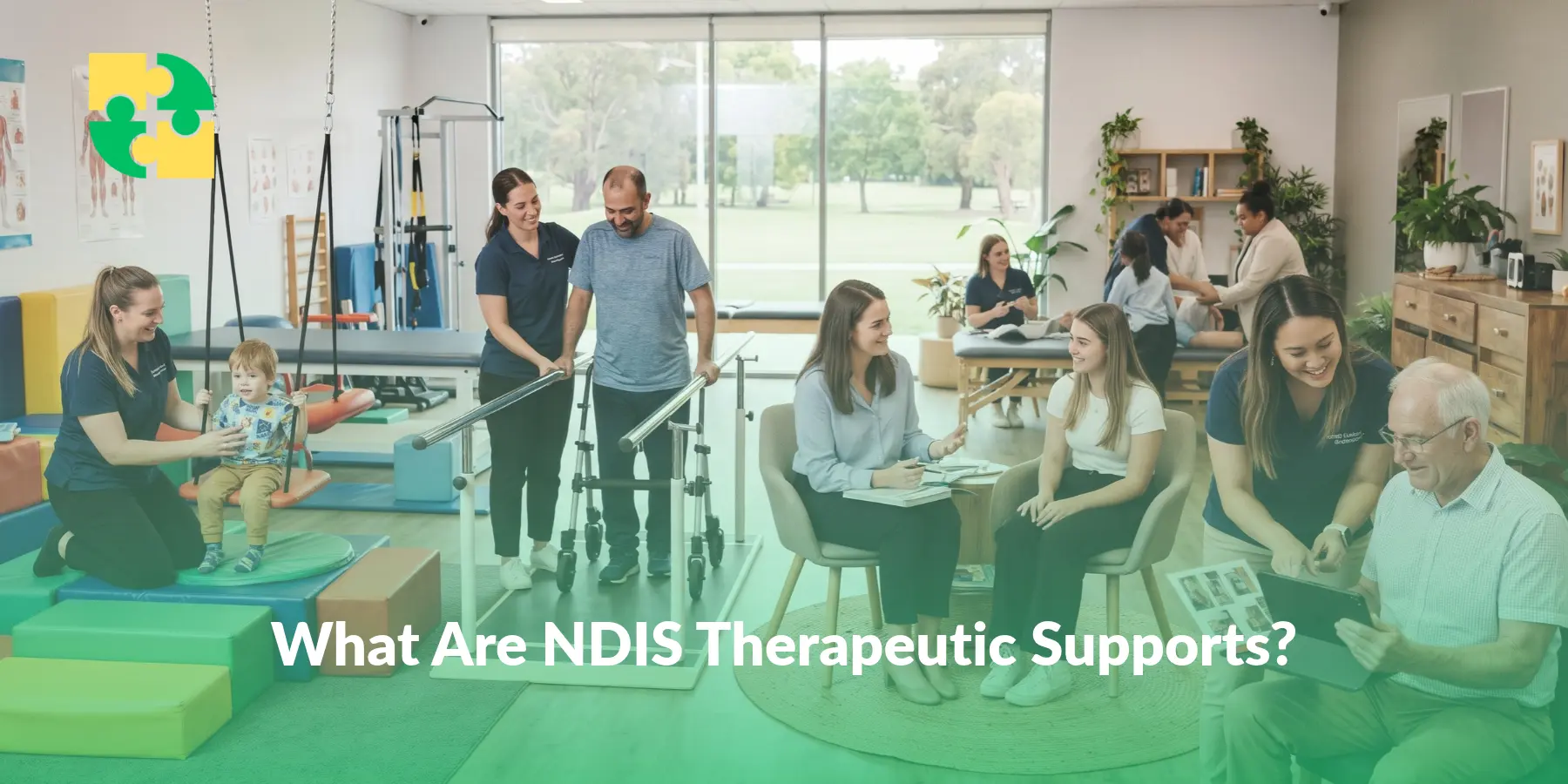



NDIS therapeutic supports help people with disability build or maintain skills, improve independence and participate more confidently in everyday life. These supports may include occupational therapy, speech pathology, physiotherapy, psychology and other allied health services, depending on a participant’s needs and NDIS funding criteria.
Whether someone needs help with communication, mobility, emotional wellbeing or daily living tasks, therapy can support practical goals at home, school, work and in the community.
In this guide, we explain what NDIS therapeutic supports are, which services may be funded, who can provide them, how funding works and what to consider before choosing a provider.
What Are NDIS Therapeutic Supports?
NDIS therapeutic supports are services designed to help people with disability improve or maintain their functional skills and independence. They are generally delivered by qualified allied health professionals using evidence-based approaches.
For example, a child may work with a speech pathologist to improve communication, while an adult may see an occupational therapist to develop safer and more independent cooking skills.
Therapy supports can focus on two main areas:
- Capacity building:
Developing new skills or improving existing abilities to increase independence.
- Maintenance therapy:
Maintaining functional abilities or helping prevent or delay a decline in everyday skills.
Some participants benefit from a combination of both. The type and amount of therapy needed will depend on individual circumstances, goals and the evidence supporting the recommended services.
Types of NDIS Therapeutic Supports
The NDIS recognises several types of therapy support, provided they meet the relevant funding criteria.
1. Occupational Therapy
Occupational therapy (OT) helps people develop the skills needed for everyday activities. An occupational therapist may help with personal care, daily routines, sensory needs, assistive equipment or home assessments.
For example, an OT may help someone develop strategies for dressing independently or recommend equipment that makes daily tasks safer.
2. Speech Pathology
Speech pathology supports communication, language, speech and, where appropriate, eating and swallowing difficulties.
A speech pathologist may help a child communicate their needs more effectively or support an adult with communication difficulties following a disability-related change.
3. Physiotherapy
Physiotherapy focuses on movement, mobility, strength, balance and physical function.
Depending on the participant’s needs, a physiotherapist may develop an exercise program or recommend strategies to improve safe movement and everyday participation.
4. Psychology and Counselling
Psychology and counselling may support emotional regulation, coping strategies, behaviour, interpersonal relationships and psychosocial functioning.
Funding depends on the purpose of the service, the participant’s disability-related needs and the applicable NDIS criteria.
5. Other Allied Health and Therapy Supports
Other services that may be funded, when eligible, include:
- Dietary support:
Assistance with disability-related nutrition and feeding needs.
- Exercise physiology:
Structured exercise to support functional goals.
- Audiology:
Assessment and support for hearing-related needs.
- Podiatry:
Foot health and function.
- Developmental education:
Support for learning and functional development.
- Social work:
Assistance with disability-related functional and participation goals.
- Art therapy and music therapy:
Therapeutic approaches that must meet the relevant evidence and funding requirements.
- Rehabilitation and vocational counselling:
Support related to rehabilitation or functional participation.
Not every service will be funded for every participant. The NDIS considers whether the particular support meets its funding criteria and is appropriate for the person’s disability-related needs.
Who Can Provide NDIS Therapeutic Support?
Therapy support must be delivered by appropriately qualified allied health professionals who meet the NDIS requirements for their profession.
Depending on the profession, this may mean registration with the Australian Health Practitioner Regulation Agency (AHPRA) or accreditation through a relevant professional peak body.
Before choosing a therapist, consider asking:
- What qualifications and professional accreditation do you hold?
- Have you worked with people with similar support needs?
- How will the therapy relate to my NDIS goals?
- How will progress be measured and reported?
- What are your fees, cancellation terms and reporting costs?
Professional requirements vary by discipline. Check a practitioner against the standards for their own profession rather than assuming every therapist needs the same credential.
Therapy assistants may help participants practise an established program where appropriate, but they should not be assumed to qualify independently as the allied health professional delivering the therapy support.
How Are Therapeutic Supports Funded in an NDIS Plan?
Therapy supports have commonly been funded through the Capacity Building budget, under the Improved Daily Living category. Participants should check their current plan and applicable support rules because NDIS funding arrangements are changing.
The NDIS generally funds therapy support according to the support categories and conditions in a participant’s plan. Funding allocated to a specific support cannot automatically be transferred to an unrelated purpose.
Funding is not automatic.
The NDIS considers whether the requested support meets the applicable funding criteria, including whether it relates to the participant’s disability and is likely to provide appropriate functional benefits.
A therapist may also be asked to provide an assessment, recommendations or a progress report to help explain the participant’s needs and outcomes.
What Does “Reasonable and Necessary” Mean?
When considering support requests, the NDIS applies its funding criteria. Evidence may need to show that the proposed therapy:
- Relates to the participant’s disability-related support needs.
- Is likely to improve or maintain relevant functional skills.
- Is supported by appropriate evidence and professional recommendations.
- Represents an appropriate use of NDIS funding.
- Is not more appropriately funded by another service system, such as mainstream health or education.
The outcome depends on the participant’s circumstances and the rules that apply to their plan.
How to Request Therapeutic Supports
If you believe therapy could help you or someone you support, preparation can make the planning process clearer.
Step 1: Identify your goals.
Explain what you want to achieve in everyday life. For example, you may want to communicate more effectively, move around your home more safely or manage daily routines with greater independence.
Step 2: Gather supporting evidence.
Reports from relevant allied health professionals can explain your functional difficulties, recommended therapy and expected outcomes. Ask your planner or the NDIA how assessments and reports can be funded before arranging them.
Step 3: Explain the recommended support.
Your evidence should describe the type of therapy required, why it is appropriate, the expected frequency or duration where known, and how it relates to your goals.
Step 4: Discuss how progress will be measured.
Ask your therapist how they will evaluate progress and when they recommend reviewing the therapy plan. Measures may include changes in functional skills, participation or the ability to complete everyday tasks.
Step 5: Check your plan and funding rules.
Before booking regular sessions, confirm that the support is covered by your current plan, understand any restrictions and clarify what costs can be claimed.
What Therapeutic Supports May Not Be Funded?
A therapy service is not automatically eligible for NDIS funding simply because a qualified professional offers it.
The NDIS requires sufficient evidence that a therapy is effective and likely to produce appropriate functional outcomes related to the participant’s disability.
Some therapies and services, including certain alternative or complementary therapies, animal therapies, massage, personal training and wellness or coaching services, may not be funded as NDIS therapy supports. Gym or swimming pool memberships are also generally not funded as therapy supports.
The funding decision depends on the applicable rules and the nature and purpose of the service. Some services may be available through other systems or paid for privately.
Check the current NDIS therapy supports guidance before committing to a program.
NDIS Therapy Costs and Price Limits
NDIS therapy costs vary depending on the service, provider, location and type of appointment.
The NDIS publishes pricing schedules that specify maximum prices for relevant supports. The applicable rules depend partly on how the participant’s plan is managed.
For NDIA-managed and plan-managed participants, the published maximum price limits apply to relevant claims. Self-managed participants have greater flexibility and may pay above those limits, subject to their plan funding and other applicable requirements.
Prices may also differ between metropolitan, remote and very remote areas.
Before starting therapy, ask the provider for a written quote that explains:
- The cost per session.
- The expected session length and frequency.
- Any assessment or report-writing fees.
- Travel and cancellation charges, where applicable.
- The estimated total cost of the recommended program.
Check the current pricing schedule rather than relying on older online price lists.
NDIS Therapeutic Supports: Important Changes in 2026–27
NDIS funding arrangements are changing, and these changes may affect some therapy budgets.
From 1 October 2026, the Australian Government began introducing funding resets over 12 months. The announced reductions are 10% for Improved Daily Living Skills budgets and 50% for Social, Economic and Community Participation budgets.
The changes are being introduced gradually as new plans are created or existing plans are reassessed from 1 October 2026, or renewed from 1 February 2027. Participants can continue using their current plans until their new or renewed plans take effect.
The reductions apply to the specified budget categories, not every part of a participant’s plan. Some supports within the affected categories are exempt, including specified employment supports, disability-related health supports, high-intensity supports, intensive and complex behaviour supports, customised and wearable technology, and hearing services.
Safeguards for Participants With High Support Needs
A specific plan variation pathway is available for eligible participants with high support needs who require 24-hour funded NDIS disability support.
To qualify under this pathway, a participant must generally:
- Have a combined plan budget of at least $215,030 before the funding is reset across Assistance with Daily Life, Home and Living, and Assistance with Social, Economic and Community Participation.
- Receive 24-hour funded NDIS support for needs arising directly from the impairments for which they access the NDIS.
Eligible participants can apply for a plan variation within 90 days of the funding reset being applied to their plan. They must also meet the applicable criteria showing that the reduced funding is insufficient to maintain safe 24-hour support at the required support ratio.
If approved, the NDIA may increase funding for specified supports to help maintain safe 24-hour disability support. This safeguard is not automatic for everyone with high support needs.
Participants who do not qualify for this particular pathway may still be able to request a plan variation or an unscheduled reassessment if they experience a significant and ongoing change in their support needs, functional capacity or circumstances.
The effect of the funding changes will differ from person to person. If you are contacted about a reassessment or renewal, review your plan carefully and discuss any concerns about your ongoing support needs with the NDIA or your planner.
Tips for Getting the Most from Your Therapy
A clear plan and regular communication can help make therapy more useful.
- Choose a qualified professional who understands your goals and support needs.
- Ask for an explanation of the therapy approach and expected outcomes.
- Agree on realistic goals and a way to measure progress.
- Find out what you can practise between sessions, where appropriate.
- Review the program regularly and discuss any concerns with your therapist.
- Keep reports, quotes and invoices organised.
- Monitor your remaining plan funding and check the rules before changing providers or services.
Family members and carers may also be able to receive training to help a participant practise everyday skills safely, where this is appropriate and funded.
Conclusion
NDIS therapeutic support can help people with disability develop skills, maintain functional abilities and participate more independently in everyday life.
The most suitable therapy will depend on the individual’s goals, support needs and the evidence behind the recommended service. Understanding provider qualifications, funding conditions and current NDIS rules can help participants make informed decisions.
Because NDIS funding and planning arrangements are changing, always check official guidance and your current plan before committing to a therapy program.
Frequently Asked Questions
NDIS therapeutic supports are eligible therapy services intended to help people with disability improve or maintain functional skills and independence in everyday life.
Examples include occupational therapy, speech pathology, physiotherapy, psychology, dietary support and exercise physiology. Funding depends on the specific service, the participant’s needs and the applicable NDIS criteria.
No. Therapy funding depends on the participant’s circumstances, plan and the relevant funding criteria. It should not be assumed to be included in every plan.
Maintenance therapy may be funded when it meets the relevant criteria. It can help a participant maintain functional abilities or prevent or delay a decline in everyday skills.
Yes. Published maximum price limits apply to relevant claims for NDIA-managed and plan-managed participants. Self-managed participants have different pricing flexibility.
Review your current plan, check the official NDIS therapy support guidance and ask the NDIA, your planner or your plan manager to clarify any restrictions before arranging services.
Disclaimer: This article provides general information only and is not legal, financial or individual NDIS funding advice. Eligibility and funding decisions depend on the applicable rules and each participant’s circumstances.