

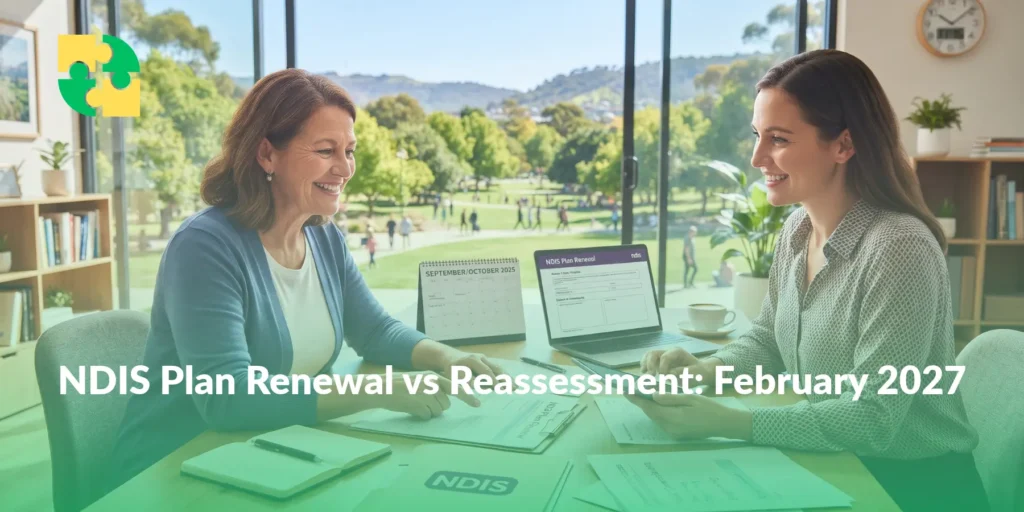
The Australian NDIS is introducing important changes to plan renewals, reassessments and funding arrangements in 2027. Understanding the difference between these processes can help participants and their families prepare for upcoming changes and make informed decisions about their support.
A plan renewal will replace the current plan continuation process from February 2027. A reassessment will continue to provide a more detailed review of a participant’s needs and circumstances. Under the new renewal process, unspent funds from the previous plan will not carry over to the new plan.
Here’s what NDIS participants need to know about the changes, key dates and practical steps to take.
The Quick Version
- Plan renewal:
Replaces plan continuation from February 2027 and provides a new plan with the same support as the previous plan.
Reviews whether a participant’s existing support remains appropriate and whether changes are needed.
- Unspent funding:
Funds left in a previous plan will not carry over when a plan is renewed.
- Funding changes:
From October 2026, funding for certain support categories will be progressively reset as plans are created, reassessed or renewed.
- Existing plans:
Participants can continue using their current plans and supports until their plans are changed through the relevant process.
These changes will be introduced over time, so the impact will depend on each participant’s plan and circumstances.
What Is an NDIS Plan Renewal?
From February 2027, plan renewal will replace the plan continuation process used for many existing NDIS participants.
A plan renewal is designed to provide a new plan with the same support as the previous plan when a full reassessment is not required. Depending on the circumstances, the NDIA may arrange a review with a planner or create a new plan with the existing support.
Think of a renewal as a fresh plan that generally keeps your current support arrangements in place.
What happens during a plan renewal?
- The NDIA contacts the participant ahead of the renewal.
- Participants are expected to receive notice approximately 60 days before their renewal.
- A new plan is created with the same support as the previous plan, where appropriate.
- The new plan has its own funding arrangements and relevant dates.
- Unspent funds from the previous plan will not carry over.
The important change:
Participants should not assume that any unused funding will remain available once their new plan starts. They should check their plan dates, understand their funding arrangements and continue using supports that meet their genuine needs.
Official guidance also confirms that certain support budgets will be reset as part of the broader reforms. These funding changes are separate from the general rule about unspent funds.
What Is an NDIS Plan Reassessment?
A plan reassessment is a more detailed review of a participant’s circumstances, functional capacity and support requirements.
It helps the NDIA determine whether the current plan continues to meet the participant’s needs or whether changes are necessary.
A reassessment may be appropriate when a participant’s circumstances have changed significantly or when their support needs require a closer review.
What happens during a reassessment?
The NDIA may consider:
- Changes in the participant’s disability-related support needs.
- Progress towards existing goals and any new goals.
- Updated reports from therapists, healthcare professionals and other relevant providers.
- Changes in living arrangements, daily activities or personal circumstances.
- Whether existing supports remain appropriate and meet the applicable funding criteria.
Following the reassessment, the participant may receive a plan with the same supports, increased funding, reduced funding or different supports, depending on the circumstances and applicable rules.
A reassessment does not automatically mean funding will increase or decrease. The outcome depends on the participant’s individual needs and the evidence considered by the NDIA.
Plan Renewal vs Plan Reassessment: Key Differences
| Feature | Plan Renewal | Plan Reassessment |
|---|---|---|
| Main purpose | Create a new plan with the same supports. | Review whether supports remain appropriate. |
| Level of review | Generally a lighter-touch process. | A more detailed review of needs and circumstances. |
| Likely outcome | Existing supports are generally maintained. | Support funding may change. |
| Unspent funds | Do not carry over to the new plan. | Do not carry over to the new plan. |
| Replaces | Plan continuation from February 2027. | Continues as an existing planning process. |
| Supporting evidence | Additional information may not be needed for a straightforward renewal. | Updated evidence may be relevant to the review. |
Note: The table above uses Markdown table formatting, which displays cell borders in a rendered table.
The key distinction is that a renewal is intended to maintain existing supports where appropriate, while a reassessment provides an opportunity to review whether those supports still meet the participant’s needs.
Who Can Request an Unscheduled Plan Reassessment?
An unscheduled reassessment allows a participant’s plan to be reviewed before its usual scheduled date when circumstances warrant it.
Participants may need to consider this option when there is a significant and ongoing change in their functional capacity, support needs or circumstances.
Examples may include:
- A substantial change in disability-related support requirements.
- A significant change in living arrangements that affects support needs.
- New evidence showing that existing supports no longer adequately meet the participant’s needs.
- Other significant changes that affect the supports required.
Participants can contact the NDIA to discuss their circumstances and the appropriate process.
How can you prepare?
If your support needs have changed, keep relevant documentation, such as updated professional reports, recommendations from therapists and information explaining how your daily support requirements have changed.
The NDIA considers individual circumstances when deciding whether a reassessment is appropriate. A request does not automatically guarantee a new plan or additional funding.
Other Important NDIS Changes in 2026 and 2027
Plan renewals are only one part of the broader NDIS reforms. Several other changes are being introduced on different dates.
1. Changes to selected support budgets
From 1 October 2026, funding for certain support categories will be progressively reset as plans are created, reassessed or renewed.
The changes affect:
- Social, economic and community participation supports.
- Improved daily living skills supports.
The announced funding changes include a 50% reduction for social, economic and community participation supports and a 10% reduction for improved daily living skills supports, subject to the applicable rules and exemptions.
Not every support within these categories is affected. Certain supports, including disability-related health supports, employment supports and high-intensity supports, are excluded from the reductions under the published guidance.
Other critical supports, such as assistance with essential daily activities and home modifications, are also protected from these particular funding changes.
Participants should check the official guidance to understand which parts of their individual plans may be affected.
2. Updated reasonable and necessary criteria
From February 2027, new criteria will be introduced for determining which supports are considered reasonable and necessary for new participants’ plans.
The reforms also include clearer guidance about what parents are expected to provide for children with disabilities.
These expectations distinguish ordinary parental responsibilities from additional support a child needs because of their disability.
The new criteria will progressively apply to existing participants when their plans are reassessed.
3. New planning arrangements
A new planning approach, known as new framework planning, is scheduled to begin rolling out from April 2027.
This will be introduced progressively, with further information expected to help participants understand how the process applies to them.
The NDIS Reform Timeline
The following dates summarise the key changes announced by the Australian Government and the NDIA.
| Date | What Changes |
|---|---|
| 1 October 2026 | Selected support budgets begin to be reset as plans are created or reassessed. |
| 1 December 2026 | A 90-day timeframe for submitting claims begins. |
| 1 February 2027 | Plan renewals replace plan continuation, and funding resets apply to relevant renewed plans. |
| April 2027 | New framework planning begins to be introduced progressively. |
| July 2027 | Mandatory registration requirements expand for certain providers. |
| October 2027 | A plan management provider panel is scheduled to be established. |
| January 2028 | New NDIS access arrangements begin for new applicants, with existing participants transitioning through reassessment over time. |
Implementation dates and requirements may differ by reform and participant circumstances. Check the official NDIS website for the latest guidance.
What Should NDIS Participants Do Now?
Preparing early can help participants understand their funding, maintain access to appropriate support and avoid unnecessary confusion when their plans change.
1. Understand your current plan
Check your plan’s end date, funding categories and available budget. Knowing when your plan is due for renewal or reassessment can help you prepare in advance.
2. Use funding for genuine support needs
Review your current support with your providers and consider whether they are meeting your disability-related needs.
Do not purchase unnecessary services simply to use remaining funds. Instead, focus on receiving appropriate support in accordance with your plan and the applicable NDIS rules.
3. Keep records and submit claims promptly
From 1 December 2026, the new 90-day claims timeframe will apply to relevant claims. Providers and participants should check the applicable requirements and ensure claims are submitted within the permitted period.
4. Gather relevant supporting evidence
If your circumstances have changed, updated reports and recommendations may help explain your support needs during a reassessment.
Ask your relevant providers what documentation would be useful for your situation.
5. Clarify which planning process applies
If the NDIA contacts you about your plan, ask whether the process is a renewal, reassessment, variation or another type of plan change.
Understanding the process can help you know what information may be needed and what to expect next.
6. Understand your review rights
If the NDIA makes a decision you disagree with, check the decision letter and the applicable review process and deadlines. Many reviewable decisions have a three-month timeframe for requesting an internal review, although the rules depend on the type of decision.
Seek advice from an appropriate disability advocacy service if you need help understanding your options.
Conclusion
The difference between an NDIS plan renewal and a plan reassessment is important for participants preparing for the 2027 reforms.
A plan renewal creates a new plan that generally retains existing supports, while a plan reassessment takes a closer look at whether those supports continue to meet the participant’s needs.
The changes to unspent funds and selected support budgets also mean that participants should understand their plan dates, review their funding arrangements and seek clarification when necessary.
The best approach is to stay informed, keep relevant documentation up to date and work with your providers to ensure your support continues to meet your needs.
Disclaimer: This article provides general information about Australian NDIS reforms and is not legal, financial or individualised NDIS advice. Rules and implementation details may change. Check the official NDIS website or contact the NDIA for information about your circumstances.
Frequently Asked Questions
- Will unspent NDIS funding carry over after February 2027?
Under the announced plan renewal rules, unspent funds from a previous plan will not carry over to the renewed plan. Participants should check their plan dates and understand how the rules apply to their particular funding arrangements.
- Does a plan renewal mean my funding will stay the same?
A renewal is intended to provide a new plan with the same support as the previous plan where appropriate. However, separate funding changes may affect certain support categories, so the total funding available may not necessarily remain unchanged.
- Can I request a reassessment if my needs change?
Participants can request an unscheduled reassessment when there is a significant and ongoing change in their circumstances, functional capacity or support needs. The NDIA will consider the circumstances and applicable requirements.
- Will the new rules affect every NDIS support?
No. The announced funding resets apply to specified support categories, and some supports within those categories are exempt. Other critical supports are not affected by these particular funding reductions.
- Do I need to submit new reports for a plan renewal?
A straightforward renewal may not require additional information. However, if your circumstances have changed or your support needs require reassessment, relevant updated evidence may be useful.